
What a bleed does
Treble bleed · Understand · Part 2 of 3
The first part showed why turning the volume down loses the highs. This part looks at what a bleed does about it, the usual ways to build one, and where a fixed bleed falls short.
What a bleed does
Open full size
Download PNG
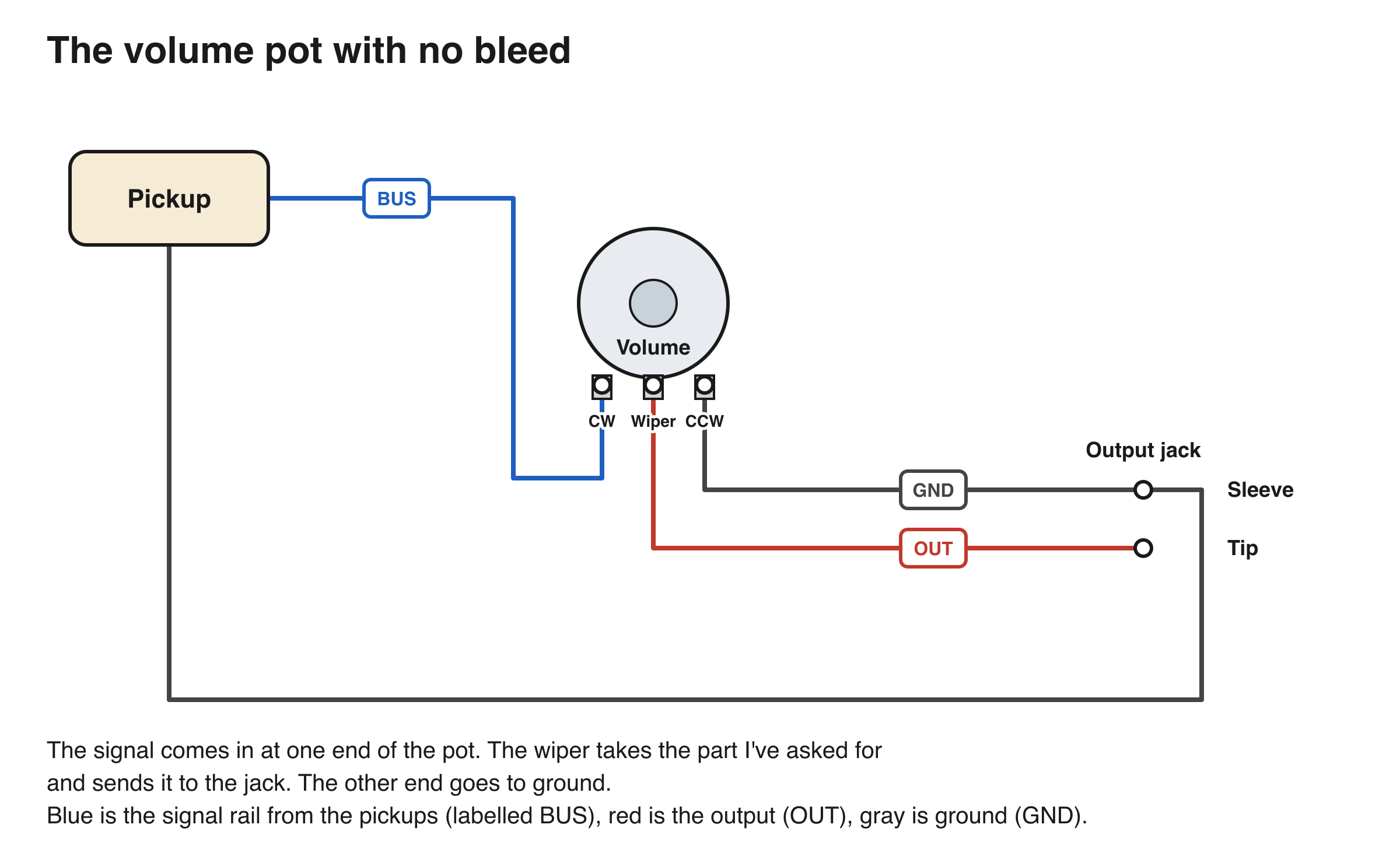
This is a volume pot with nothing added. The colored tags name the wires, and the same names appear in every diagram that follows:
- BUS (blue) is the main signal wire from the pickups. It lands on the pot's input end.
- OUT (red) is the output. It runs from the wiper to the tip of the output jack, which is the connection that carries the signal to the amp.
- GND (gray) is ground. It runs from the pot's ground end to the jack's sleeve, the outer connection of the jack.
Open full size
Download PNG
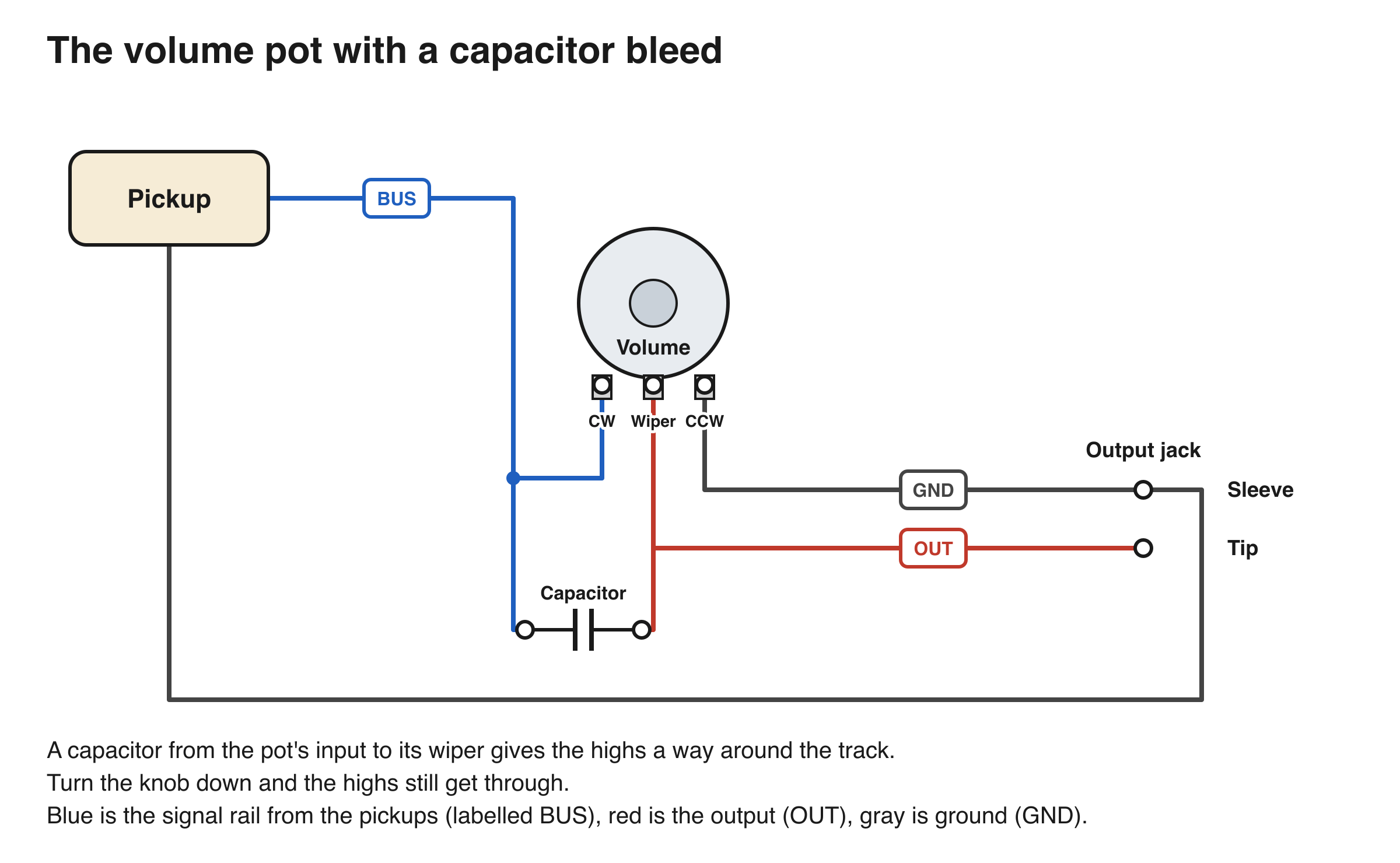
A treble bleed adds a path around the pot. In this simplest version, a capacitor connects the pot's input end directly to its wiper. Because a capacitor passes highs easily, the highs can skip past the track instead of pushing through it. The lows can't take that shortcut, so they still go through the track and still get turned down.
The result is that turning the volume knob still makes the guitar quieter, but the highs fade less as you go.
The usual variants
Open full size
Download PNG
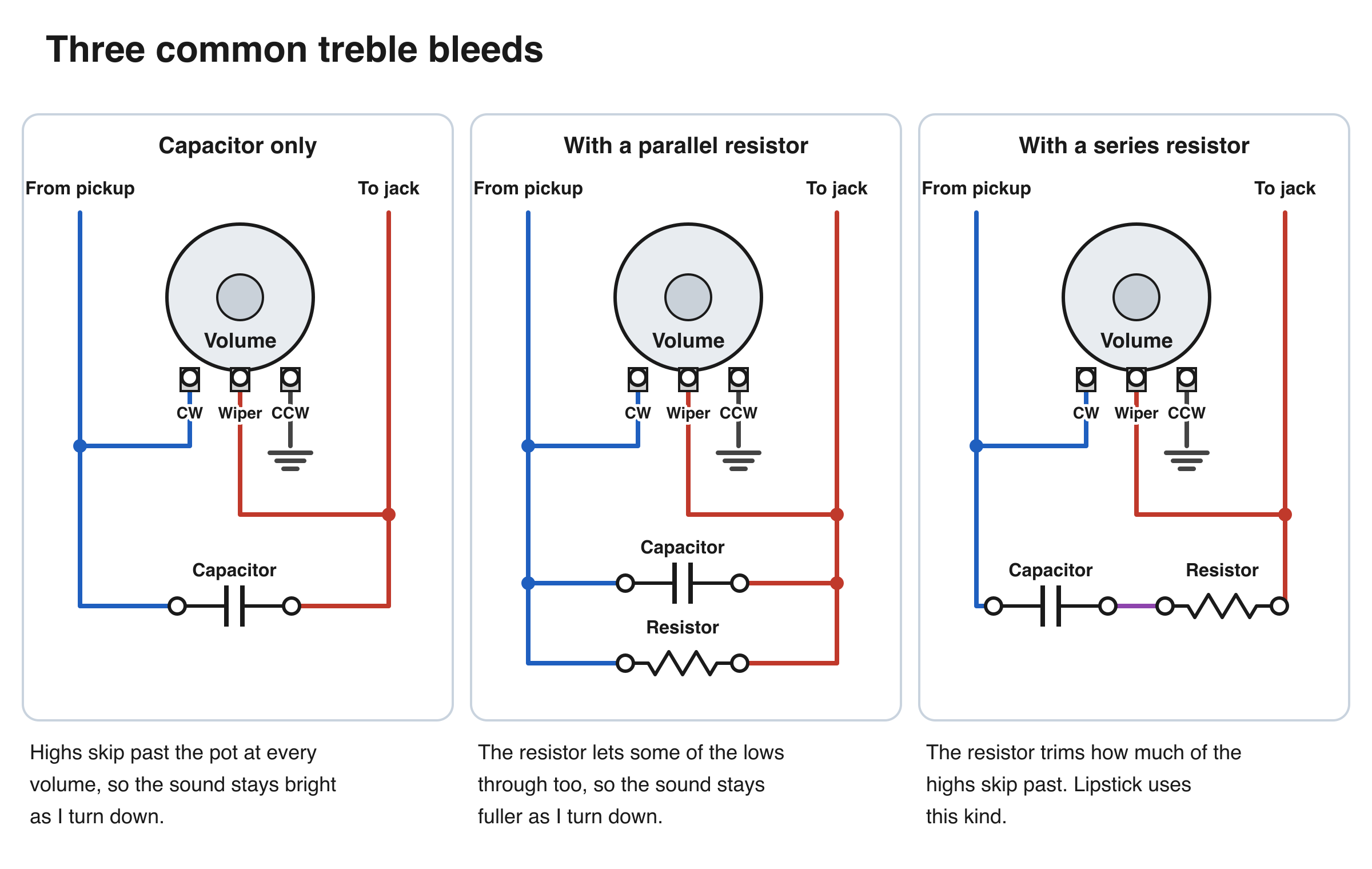
Treble bleeds come in three common shapes. All three sit across the volume pot, from the input end to the wiper.
- Capacitor only. The highs skip past the pot at every volume setting, so the sound stays bright as you turn down. Because only the highs skip past, this kind can leave the sound thin as you turn down.
- Capacitor with a parallel resistor. The resistor sits beside the capacitor and lets some of the whole signal, lows included, skip past too, which keeps the sound from turning thin as you turn down. It also changes how quickly the knob turns the volume down.
- Capacitor with a series resistor. The resistor sits in line with the capacitor and trims how much of the highs skip past. Relay Lipstick uses this kind: a 1 nF capacitor and a 150 kΩ resistor in series.
The values of the parts set how strong each one is. They are chosen to suit the pot and tuned by ear.
Where fixed bleeds disappoint
Every bleed above is a fixed bleed. Its parts connect to the volume pot and to nothing else, so it has no way of knowing where the tone knob is.
That matters when you use both knobs together. Rolling the tone knob back is a way of asking for a darker sound. Turn the volume down at the same time, and the fixed bleed keeps doing its job: it keeps passing highs around the volume pot, just as it would at full tone. The tone knob still works, but the bleed is still adding brightness, so rolling the tone back doesn't tame it the way you might expect.
In the illustration in the first part, the orange "Fixed bleed" line stands for every tone setting: the bleed does the same thing wherever the tone knob is.