
Is your guitar a fit?
Treble bleed · Build · Part 1 of 5
This is an alternative tone wiring. It adds one small three-position switch that changes what the treble bleed on your volume pot does: Direct gives an ordinary treble bleed, Off gives no bleed at all, and Reactive gives a bleed that follows the tone knob. It suits any guitar wired with one master volume and one master tone, and it needs one new hole for the switch.
I have built this circuit and validated it on Relay Lipstick. If the ideas behind it are new to you (what a bleed is, why turning down makes a guitar dull, and how a bleed can follow the tone knob), the Understand series explains them with pictures. This series is the hands-on part, in five short parts: this one checks that your guitar is a fit, then come the parts and the hole, what changes and finding your lugs, the wiring and its checks, and a reference sheet with troubleshooting. If you have done this kind of work before, the reference sheet has the whole circuit on one page.
What you get
| Mode | What you hear as you turn the volume down |
|---|---|
| Direct | An ordinary treble bleed. The highs stay as you turn down, wherever the tone knob is. |
| Off | No bleed. The guitar gets darker as you turn down, and the tone knob works as usual. |
| Reactive | A bleed that follows the tone knob. At full tone it matches Direct; roll the tone back and it eases. |
Two settings make the switch easy to check by ear. With the volume all the way up, all three modes sound the same, because the bleed has nothing to skip past. With the tone all the way up, Direct and Reactive sound the same, because the tone pot then passes the signal straight to the bleed. The bench checks in part 4 use both.
Is your guitar a fit?
Open full size
Download PNG
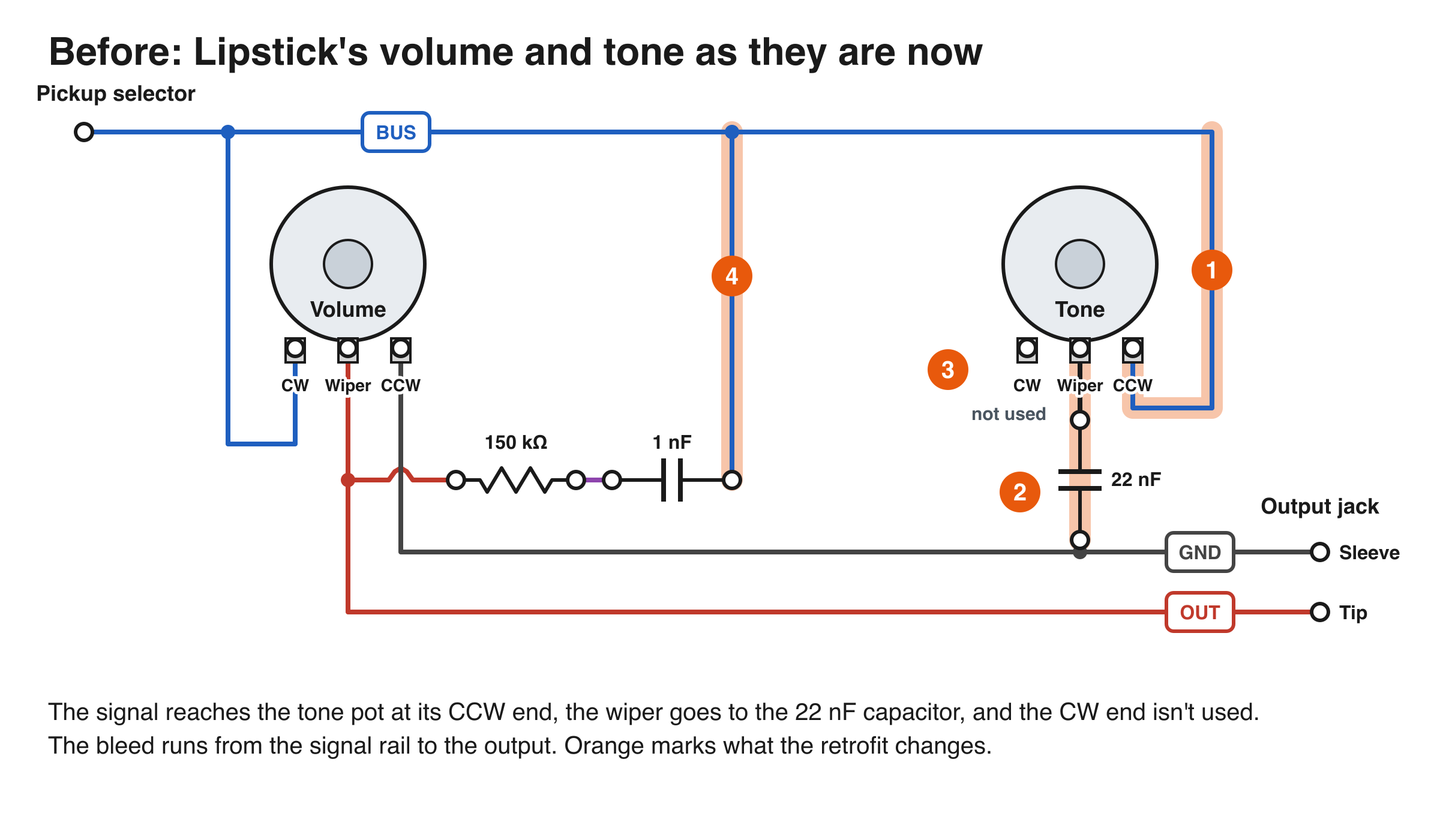
Diagram 11 is the circuit your guitar needs to have before you start. It is Relay Lipstick's stock wiring, and the orange marks show the four places the retrofit changes. The colored tags name the wires:
- BUS (blue) is the main signal wire from the pickup selector. It lands on the volume pot's input end.
- OUT (red) runs from the volume pot's wiper to the tip of the output jack, the connection that carries the signal to the amp.
- GND (gray) is ground, the shared return wire. It joins the volume pot's ground end, the tone capacitor and the jack's sleeve.
Your guitar is a fit when all of these are true:
- One master volume and one master tone. The pickup selector feeds both, and nothing else sits between them and the jack.
- The tone pot hangs off the volume pot's input side. One tone pot lug is on BUS, another goes through one capacitor to ground, and the third is unused. Lipstick has BUS on an end lug and the capacitor on the wiper, as in Diagram 11, but it doesn't matter which lug has which now: the retrofit rewires the tone pot anyway.
- The volume pot is 250k, 500k or 1M. All three work. The value table in part 2 gives the bleed parts for each.
- The volume pot has no bleed, or a series bleed. A series bleed is a resistor and a capacitor joined end to end in a chain from the volume pot's input lug to its wiper, like Lipstick's. If yours has one, you reuse its two parts. If it has none, this series adds one.
It is not a fit when any of these is true:
- The tone pot is fed from the volume pot's wiper instead of its input, or the tone circuit carries extra parts beyond its one capacitor.
- The bleed is some other kind: a capacitor alone, or a resistor and capacitor side by side (in parallel, sharing both ends).
- The guitar has two independent volume knobs whose signals meet at one output. This includes Relay Reef and Reef Plus. With two volumes sharing an output, a bleed on one volume can pull highs from the other.
To confirm the fit, unplug the guitar and set your meter to continuity (the setting that beeps when two points are connected). Seen from the back, with the shaft pointing away and the lugs at the bottom:
- Set the tone knob to about 5, so its wiper sits away from both ends. Touch one probe to the volume pot's left lug, its input end (if you're unsure which lug that is, confirm it with the meter as in Identify your lugs). Touch the other probe to each tone pot lug in turn. Exactly one tone lug should beep. That tone lug is on BUS. The other two only reach BUS through half or all of the tone pot's track, which is far too much resistance to beep.
- Set the volume knob to about 5, so its wiper sits away from both ends. Move the first probe to the volume pot's middle lug, its wiper, and touch each tone pot lug again. None should beep. If one does, the tone pot is fed from the wiper, and the guitar is not a fit.
- Look at the other two tone pot lugs. One should carry a single capacitor whose other lead goes to ground (to the back of a pot or to the ground wire). The other should have nothing on it.
- Look at the volume pot. Between its left lug and its middle lug there should be nothing, or one resistor and one capacitor joined end to end, with nothing else at the joint where they meet.