
PRS26001 · Rev 2.0 · November 13, 2026
PRS SE Custom 24 Burled Ash wiring reference
The five-way selector gives the bridge humbucker, a bridge partial split, both partial splits together, a neck partial split, and the neck humbucker. Pulling the tone knob takes the tone control out of the circuit; it changes no pickup connection.
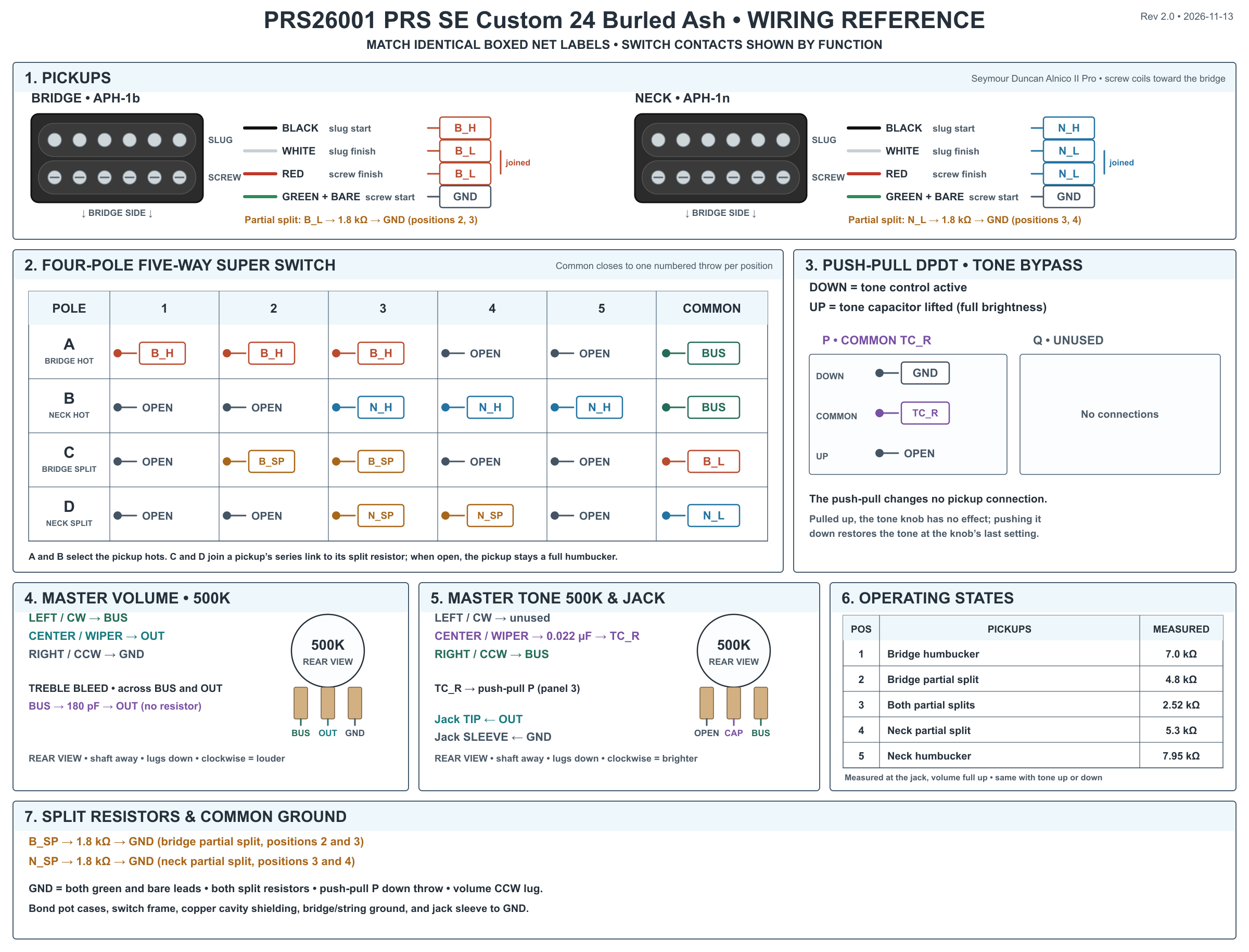
What each switch position does
| Five-way position | Tone pushed down | Tone pulled up |
|---|---|---|
| 1 | Bridge humbucker | Bridge humbucker, tone bypassed |
| 2 | Bridge partial split | Bridge partial split, tone bypassed |
| 3 | Bridge and neck partial splits together | Bridge and neck partial splits together, tone bypassed |
| 4 | Neck partial split | Neck partial split, tone bypassed |
| 5 | Neck humbucker | Neck humbucker, tone bypassed |
Measured at the output jack with the volume full up, the same with the tone pushed down or pulled up: position 1, 7.0 kΩ; position 2, 4.8 kΩ; position 3, 2.52 kΩ; position 4, 5.3 kΩ; position 5, 7.95 kΩ.
Parts
Manufacturer pickup specifications: Seymour Duncan humbucker coil and lead guide.
- Seymour Duncan APH-1b and APH-1n Alnico II Pro humbuckers with four-conductor leads, both mounted with the screw coil toward the bridge. White and red are joined as each pickup’s series link.
- Oak Grigsby four-pole five-way super switch.
- 500 kΩ master volume with a 180 pF treble-bleed capacitor (no resistor) from its input to its wiper.
- 500 kΩ push-pull master tone with DPDT switch, 0.022 µF film tone capacitor, and mono output jack.
- Two 1.8 kΩ partial-split resistors.
Functional switch contacts
Contacts are shown by function. In each blade position, each pole common closes to one numbered throw. Poles A and B select the pickup hots; poles C and D connect a pickup’s series link to its split resistor.
| Pole and common | 1 | 2 | 3 | 4 | 5 |
|---|---|---|---|---|---|
| A / BUS | B_H | B_H | B_H | open | open |
| B / BUS | open | open | N_H | N_H | N_H |
| C / B_L | open | B_SP | B_SP | open | open |
| D / N_L | open | open | N_SP | N_SP | open |
The push-pull DPDT on the master tone uses one pole. Pushed down, pole P connects the tone capacitor return TC_R to GND, so the tone control works. Pulled up, P leaves TC_R open: the tone knob has no effect and the guitar is at full brightness. Pushing it back down restores the tone at the knob’s last setting. Pole Q is unused, and the push-pull changes no pickup connection.
Connection map
| Net | Connect these points |
|---|---|
| B_H / N_H | Bridge black lead to super-switch A1, A2, and A3; neck black lead to super-switch B3, B4, and B5. |
| B_L / N_L | Each pickup’s white and red leads joined; bridge to super-switch C common, neck to super-switch D common. |
| B_SP | Super-switch C2 and C3, then a 1.8 kΩ resistor to GND. |
| N_SP | Super-switch D3 and D4, then a 1.8 kΩ resistor to GND. |
| BUS | Super-switch A and B commons, volume CW lug, treble-bleed capacitor, and tone CCW lug. |
| OUT | Volume wiper, treble-bleed capacitor, and output-jack tip. |
| TC_J / TC_R | Tone wiper through the 0.022 µF capacitor to TC_R, which goes to push-pull P common. The tone CW lug is unused. |
| GND | Both green and bare leads, both split resistors, push-pull P down throw, volume CCW lug, pot cases, switch frame, cavity shielding, bridge/string ground, and jack sleeve. |
In the diagram’s rear pot view, the shaft points away and the lugs point down. Left, center, and right are clockwise end, wiper, and counterclockwise end.