
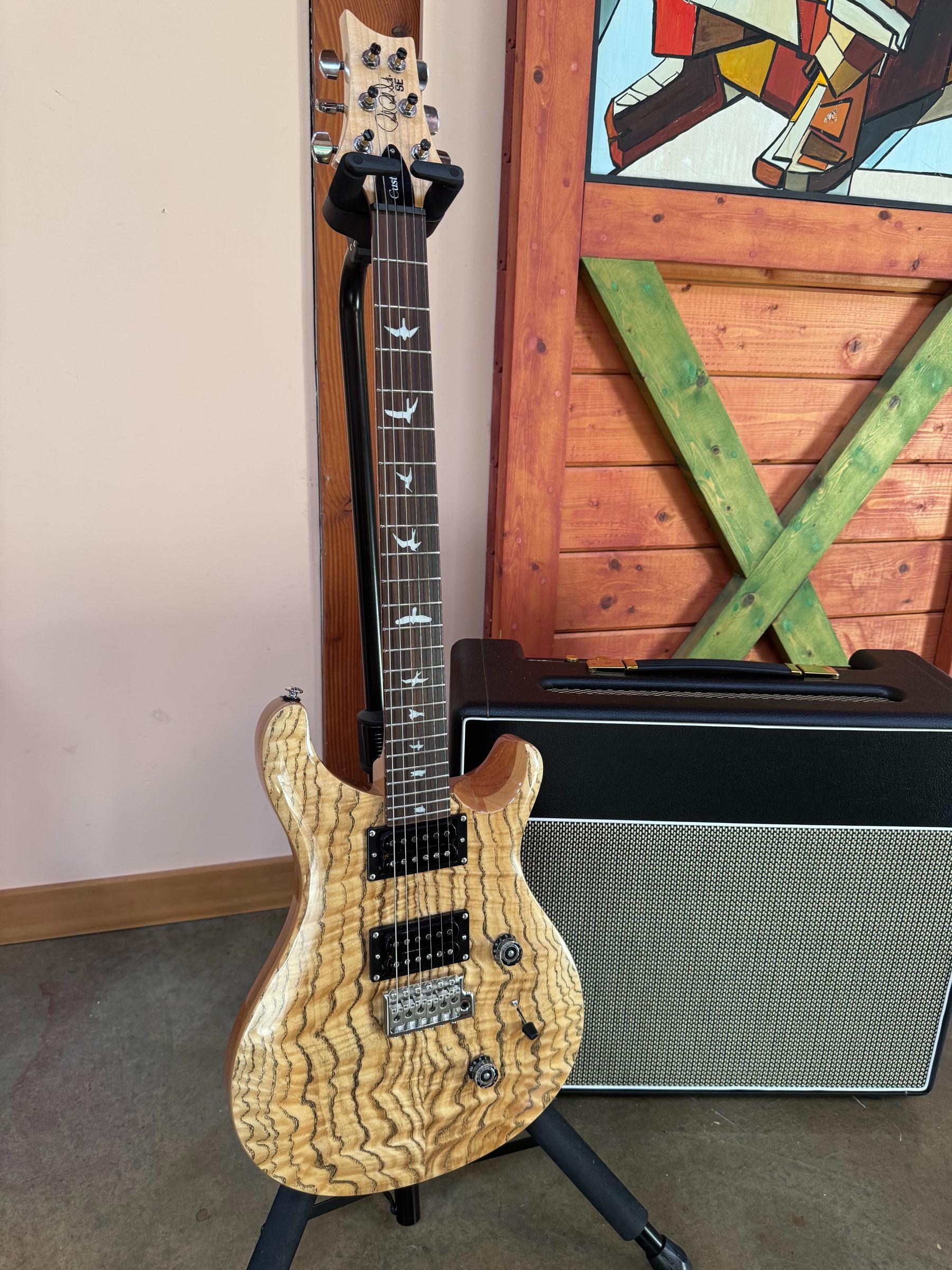
Find its voices
Voice and control map
Pickup selector
5-way selector- 1
Bridge — Full Punch
The full bridge humbucker: firm lows, a rounded attack, and enough output for rhythm or lead. - 2
Bridge Partial Split — Snap
The bridge pickup partly split: brighter and quicker than the full humbucker, with more body than a hard split. - 3
Both Partial Splits — Money Funk
Both pickups partly split and played together: open, percussive, and airy. - 4
Neck Partial Split — Touch Voice
The neck pickup partly split: open and responsive like a single coil, but with more body. - 5
Neck — Warm Voice
The full neck humbucker: warm, articulate, and expressive.
Master volume
standardnormal
Master output
Master tone
push pulldown
Tone on
up
Tone bypass
Magnetic voice
Pickup configuration
bridge
Seymour Duncan APH-1b Alnico II Pro
humbucker
- Magnet
- Alnico II
- Split
- Partial, 1.8 kΩ
neck
Seymour Duncan APH-1n Alnico II Pro
humbucker
- Magnet
- Alnico II
- Split
- Partial, 1.8 kΩ
The guitar
This is a natural-finish PRS SE Custom 24 Burled Ash Limited Edition, made in 2024. It has a burled swamp-ash veneer over a maple top, a mahogany back, a Wide Thin maple neck, and a rosewood fingerboard with bird inlays, 24 frets, and a 25-inch scale. The hardware is nickel, with a PRS molded tremolo. As part of the K7RHY rework, the original tuners were replaced with PRS locking tuners.
Where the Relay voicings started
After its rework, this guitar became the jumping-off point for Relay, the K7RHY guitar platform. Its sounds were where the Relay voicings began, each voicing being a different combination of pickups, switching, and controls on the same body. While those voicings were designed, assembled, and evaluated, it stayed on the bench as the platform-reference instrument that every new build was compared against for dynamic response, pickup balance, control utility, and clean-to-edge-of-breakup voicing.
How it plays
The Alnico II Pro pickups give the guitar a warm, touch-sensitive center. The two controls work like any two-knob guitar, and the five-way selector moves from bridge to neck in order.
Positions 1 and 5 are the full humbuckers, with the weight for stronger rhythm parts and sustained leads. Positions 2, 3, and 4 use partial splits: one coil of each selected pickup is mostly bypassed, not cut off completely, so these voices sound open and quick without turning thin. Position 3 plays both partly split pickups together.
Pulling the tone knob up takes the tone control out of the circuit. Set the knob where you like it for a darker sound, then pull up for full brightness and push down to get your setting back, without reaching for the knob mid-song.
The guitar suits blues, funk, soul, folk, jazz, and yacht rock, and especially expressive playing that moves between clean and the edge of breakup, where changes in touch and guitar volume stay easy to hear.
Electronics
The factory electronics were replaced with a Seymour Duncan APH-1b/APH-1n Alnico II Pro set, both mounted with the screw coil toward the bridge. The selector is an Oak Grigsby four-pole five-way super switch. The 500 kΩ master volume has a 180 pF treble-bleed capacitor. The 500 kΩ push-pull master tone uses a 0.022 µF film capacitor, which the push-pull disconnects when pulled up. The control cavity is shielded with copper foil.
Each partial split bridges one coil of a pickup with a 1.8 kΩ resistor: the bridge pickup in positions 2 and 3, the neck pickup in positions 3 and 4.
Wiring reference
Open the wiring reference for the full-size diagram, switch contacts, connection map, and measured resistance in each position.